
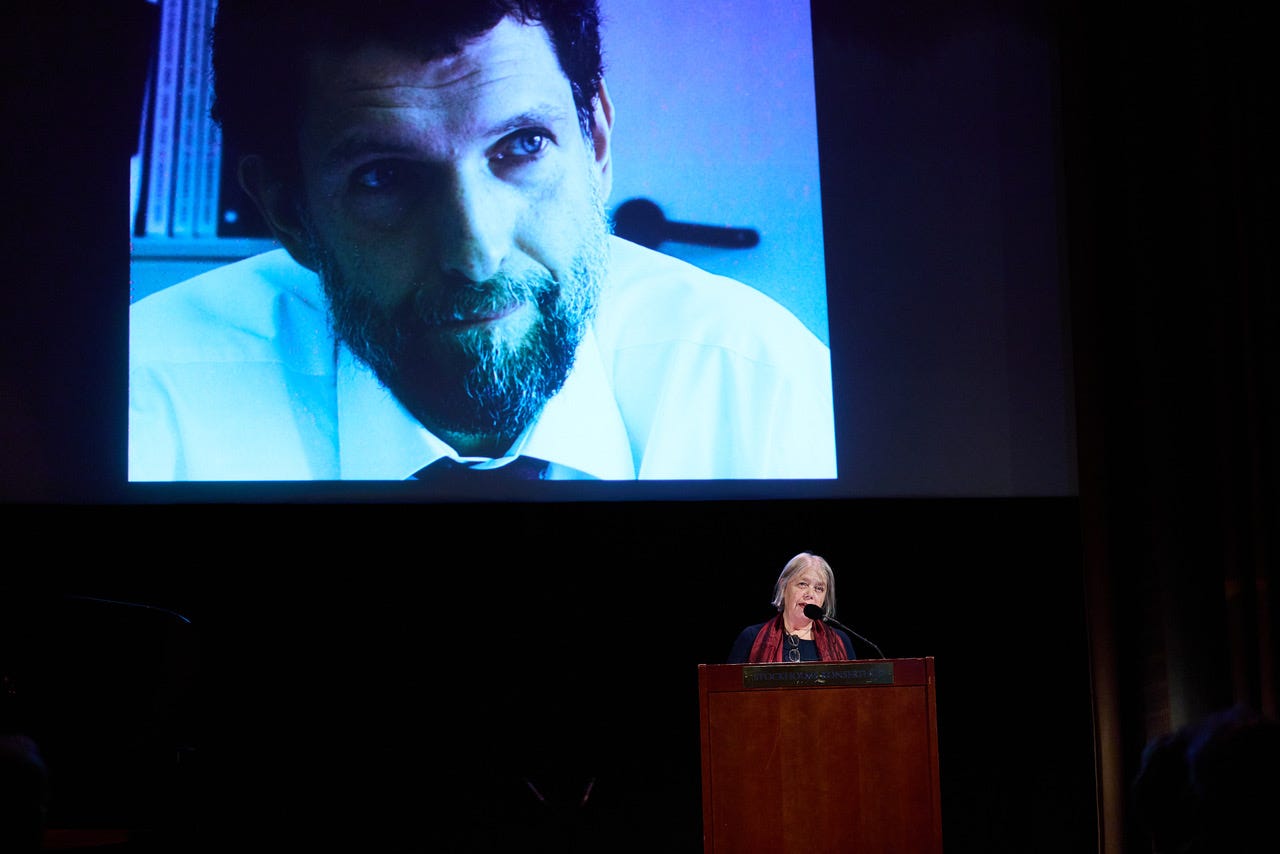
Photo: Magnus Swärd
My motivation speech, held at the ceremony in the Concert Hall in Stockholm, Konserthuset, on September 7, 2026.
Dear Guest of Honor Professor Ayşe Buğra, Distinguished Guests, Esteemed Jury,
Let me first commend the jury for presenting the Gilel Storch Award to Osman Kavala. An excellent choice.
And then a little background:
In the early 1990s, I began traveling as a journalist to Turkey, or Türkiye as the country is now officially called. In those years a devastating civil war was going on in the southeast between the state and Kurdish insurgents. Its repercussions could be felt anywhere in the country.
While speaking Kurdish in daily life was no longer automatically a crime in the 1990s, expressing political views, giving speeches, or even singing in Kurdish was often prosecuted as “separatist propaganda” under Turkey’s strict anti-terror laws.
Turkey in those years had a despicable record of torture, arbitrary killings, enforced disappearances and a crackdown on the freedom of speech.
Calling the mass killings of Armenians and other Christians in the final days of the Ottoman Empire a genocide could be prosecuted as an insult to the Turkish nation.
From these years, I will always remember a female lawyer and human rights defender who said to me that “in Turkey, every decent person has been in jail”.
Today’s Turkey is not identical to the Republic in the 1990s. But as we speak, too many decent people are in jail. And no one symbolizes those unfairly imprisoned more than Osman Kavala.
For more than a decade Turkey has been developing into a new type of authoritarian state, driven by a constitutional order that centralizes power in the Presidency, or, more precisely, to the presidential palace in Ankara.
This can be felt in every courtroom, in every police station, on every university campus, in every civil society organization, and in media newsrooms.
Against this authoritarianism, a vibrant, courageous and multifaceted civil society has been standing, and still stands – most of the time.
Osman Kavala epitomizes the spirit of civil society in Turkey. He is a businessman and philanthropist who was arrested in October 2017. For two years he was held in pre-trial detention, before he and others were indicted on baseless grounds for trying to overthrow the government and for their alleged role in the Gezi Park protests six years earlier.
In 2020 he was acquitted only to be re-arrested without being released from prison on charges of “participating in the attempt to overthrow the constitutional order ” and “espionage.”
In April 2022, nearly five years after his detention, Osman Kavala was sentenced by an Istanbul court to aggravated life imprisonment without parole for attempting to overthrow the Government of Turkey or prevent it from performing its duties.
The sentence was in reference to the nationwide anti-government Gezi Park protests in 2013. However, Kavala was acquitted of the charge of military and political espionage — the grounds for his detention. Eight co-defendants were sentenced to 18 years in prison. Four of them were later acquitted by the Turkish Court of Cassation, whereas four remain in prison: a lawyer, a city planner, a filmmaker, and a rights defender.
It was a judicial scandal. And so it remains.
The prosecutor argued that the Gezi Park protests were similar to previous uprisings in Georgia in southeast Europe, and in Tunisia and Egypt during the Arab spring, depicting these uprisings as orchestrated by foreign hands with hidden agendas, when in fact they were spontaneous outbursts of deeply felt frustration.
I know it, because I covered these events from many Arab capitals at the time.
Also, as someone who covered the Gezi Park protests as a journalist, I can confirm, like so many others, that they were not a premeditated plot. Such claims are surreal.
The judges in Strasbourg came to the same conclusion.
Osman Kavala’s innocence has been corroborated by the European Court of Human Rights which has called for his immediate release three times. First in a landmark decision in December 2019. For a second time, in July 2022, the court reiterated its call for his release. The court ruled that Turkey had failed to fulfill its obligations under the European Convention on Human Rights by refusing to execute the original release order and it launched infringement proceedings.
The second judgement also was not complied with. So lastly, on 25 August 2026, the Grand Chamber of the European Court of Human Rights ruled in a third and final and hugely important decision that Kavala’s detention and prosecution constituted a violation of several articles of the European Human Rights Convention.
The court required the Turkish state authorities to secure Kavala’s release “at the earliest possible date, and to eliminate the consequences of his conviction, which was to be regarded as null and void under Convention Law”.
For almost nine long years, Osman Kavala has been locked up in the huge Silivri Prison, later named the Marmara Prison, where he is only allowed to have visits from his lawyers and his immediate family members every second week.
After the final decision in Strasbourg, Kavala’s family, friends, the Turkish civil society and all others who care for the rule of law are waiting for the Turkish authorities to take the necessary steps to comply with the European Court’s Grand Chamber decision.
Osman Kavala is a man of peace and transparency. Throughout his life he has devoted himself to building bridges and investing in culture, art and dialogue to transform societies, to guide them away from violent clashes and towards peaceful conflict resolution and democracy.
I never got know him in person; I have admired him from a distance. But for many years I had memorable meetings with many of his colleagues in civil society.
One of them was the late Turkish-Jewish businessman Ishak Alaton, co-founder of the Open Society Foundation in Turkey. He and Osman Kavala supported initiatives that promoted democracy and citizens’ and minorities’ rights. Both were entrepreneurs who saw no contradiction between a commitment to democracy and human rights and their business enterprises.
Osman Kavala, today 69, came of age in the 1970s when Turkey’s military held sway over the secular republic and the country was polarized between leftist and right-wing movements, and between Kurdish militants and Turkish ultranationalists.
People who have known him for decades remind me of how, as a young student, he became active in a leftist movement, supporting Kurds and others.
But he was not really an ordinary student. He came from a business family, which had made its fortune in the tobacco trading industry in northern Greece during Turkey’s Ottoman past. Kavala also happens to be the name of a port city in Greece, previously a city in the Ottoman Empire. His ancestors were among the hundreds of thousands of Muslims who were forced to move from Greece to the new Republic of Turkey, while over a million Greek Orthodox Christians had to leave their homes in today’s Turkey during the huge population exchange in the early 1920s.
His name thus carries a legacy of an Ottoman multicultural past, when Turkish could be heard in the coffeehouses in Kavala, Salonika and Crete, and when Anatolia had millions of Christians of Armenian, Greek Orthodox and Syriac descent. Ottoman Istanbul, Anatolia, and the Balkans also used to have large and vibrant Jewish minorities.
In the early 1980s, Osman Kavala was a PhD student in New York. He was called back home in 1982, after the death of his father, to take over the family company, the Kavala Group. This occurred shortly after a military coup d’etat when Turkey’s prisons and detention centers were filled with dissidents, activists and militants. The testimonies of torture were harrowing.
So how did a PhD student with leftist leanings who suddenly inherited a family business handle this delicate situation?
Early on, Kavala co-founded a publishing house. Some of the texts he published were written by Kurdish inmates in the prisons of Diyarbakir in the southeast. He also co-founded an environmental organization, TEMA, as well as the Helsinki Citizens Assembly. Later he became the co-founder of a progressive and liberal think tank, TESEV.
When the armed conflict between the military and the outlawed Kurdish PKK seemed to be waning, Osman Kavala got involved in new projects: trying to heal a wounded society with the help of art and culture.
In 2002, the same year that the ruling AKP party was elected to power, Kavala founded Anadolu Kültür, which supported arts and cultural initiatives across the republic. He built an extensive network that others would benefit from, among them NGOs, EU institutions and embassies. When Sweden, in the early years of the millennium, wanted to support Turkey’s democratization process and a more EU-compatible Turkey, the Consul General in Istanbul at the time, Mr. Ingmar Karlsson, turned to Osman Kavala for advice.
”Osman was always helpful and he had contacts all over Turkey”, Ingmar Karlsson recalls.
The first project Osman Kavala helped the Swedish Consulate with was finding venues around Turkey for a photography exhibit by Ulla Lemberg, featuring Swedish dads with their children. Osman Kavala also helped distribute children’s literature which had been translated from Swedish to Kurdish languages.
Moreover, when an Istanbul university broke a taboo by hosting an international conference on Seyfo, that is the mass killings and expulsions of Assyrian/Syriac Christians from eastern Anatolia in the early 1900s, Kavala stepped in to help.
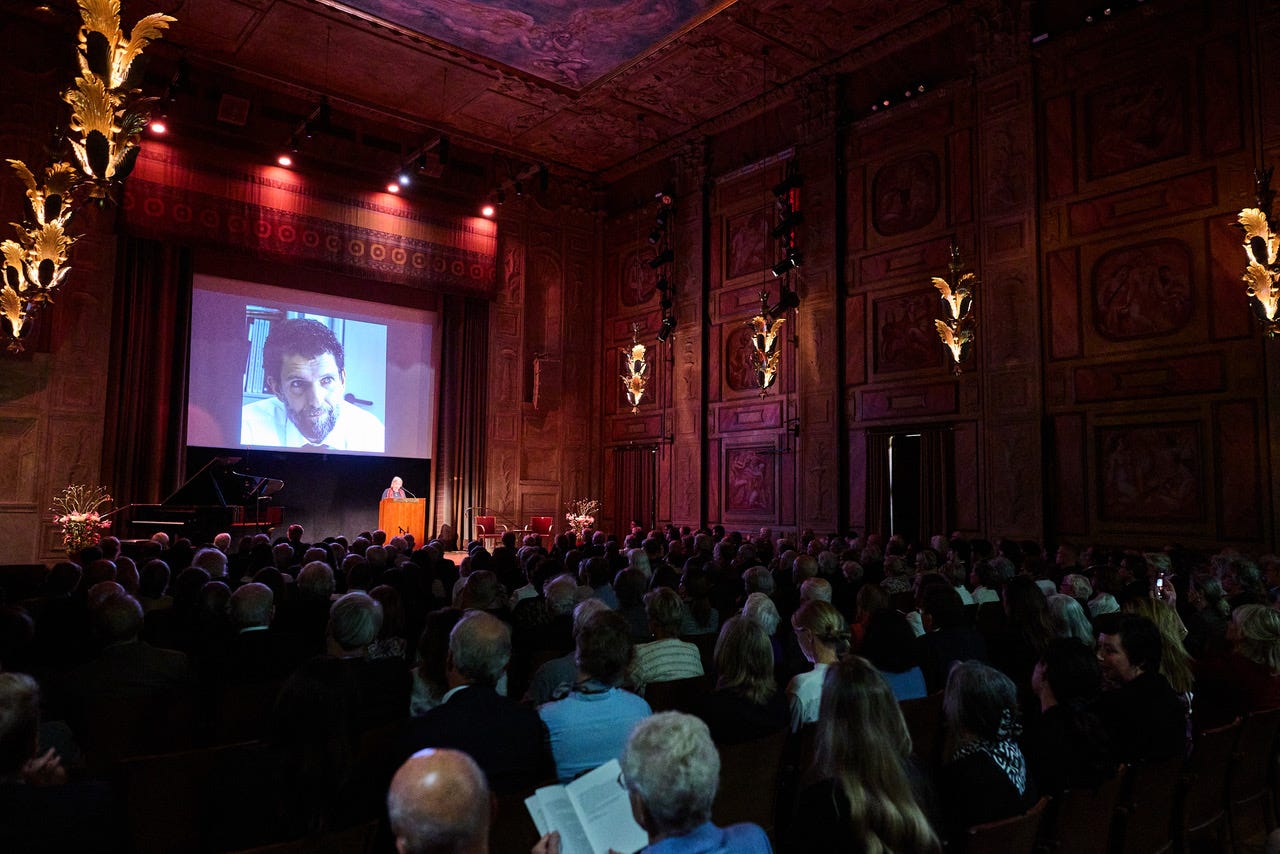
Photo: Magnus Swärd
We must not forget his commitment to promoting an Armenian-Turkish dialogue. Inspired by the West-Eastern Divan Orchestra in Berlin, founded by Edward Said and Daniel Barenboim for Jewish and Arab musicians, Osman Kavala laid the ground for a Turkey-Armenia Youth Symphony Orchestra, bringing together young musicians from both countries.
The terrible irony is that this refined and cultured person who has done so much for Turkish society is locked up for life, as if he had been a hardcore terrorist and putschist. This is both absurd and a tragedy for Turkey.
In the legal case Kavala vs Turkey, the European Court of Human Rights, with its decision on the violations of the Convention, has shown that the detention and conviction of Kavala was “predominantly motivated by an ulterior motive, namely, to punish him for his role in the Gezi Park demonstrations and for expressing his opinions as a human rights defender, and to silence him”.
It is also plausible that his imprisonment was meant to have a chilling effect on civil society at large and to discourage other human rights defenders from speaking their mind. In other words, that it was designed to foster an obedient, subservient society, contrary to any spirit of vibrant democracy.
Judgments from Strasbourg are binding for every member state of the Council of Europe, and Turkey is one of its earliest member states. As mentioned, Osman Kavala and his co-defendants were acquitted from all accusations by a Turkish court some months after the first ruling in Strasbourg. Kavala described this as the best day of his life. But before he could walk out as a free man, he was arrested again.
We must ask ourselves: why?
Reading between the lines in the judgment from Strasbourg you may find a vengeful President of the Republic, fearing freedom of speech and freedom of assembly, although President Erdogan was himself a victim of such violations in the 1990s, when he was put in prison and banned from politics, charged with reading a poem in public.
Even though the apparent purpose of keeping Kavala behind bars is to silence him and others, Turkey’s civil society cannot easily be muted. Turkey is not Turkmenistan or Tajikistan. There will always be new generations coming of age with their demands for personal dignity and political freedoms.
In prison, Kavala is still active. From his cell he recently served as the editor of the Turkish translation of Rashid Khalidi’s much acclaimed book The Hundred Years’ War on Palestine.
Osman Kavala will not be forgotten no matter how thick the gates and how high the walls of his prison are. The stamina and courage that he and his co-defendants represent scare the ruling circles in an authoritarian state – be it Turkey or any other country.
With a growing authoritarian trend worldwide, Osman Kavala’s case concerns us all.
However, civil society in Turkey appears to have lost its hope in the European Union accession process. They see European governments refrain from pushing Turkey on human rights issues fearing that it will backfire and make Ankara tilt closer towards Russia or open its gates for refugees and migrants.
As mentioned, the Council of Europe launched infringement proceedings against Turkey in 2022 due to its refusal to obey the binding judgment from Strasbourg to release Osman Kavala. We are now waiting for the infringement proceedings to be implemented.
People in the Turkish civil society that I have spoken with see another frail possibility to obtain the release of Kavala and other innocent prisoners: the current disarmament process with the PKK. Turkey’s new disarmament legislation makes no reference to the decisions of the European Court of Human Rights. But there are hopes that this process could lead to amendments of Turkey’s arbitrary anti-terror laws and open windows of opportunity. A disarmament process would also pave the way for better relations with the EU.
However, an initial step must be respect for the binding rulings of the European Court of Human Rights, starting with the release of Osman Kavala.
Thank you.
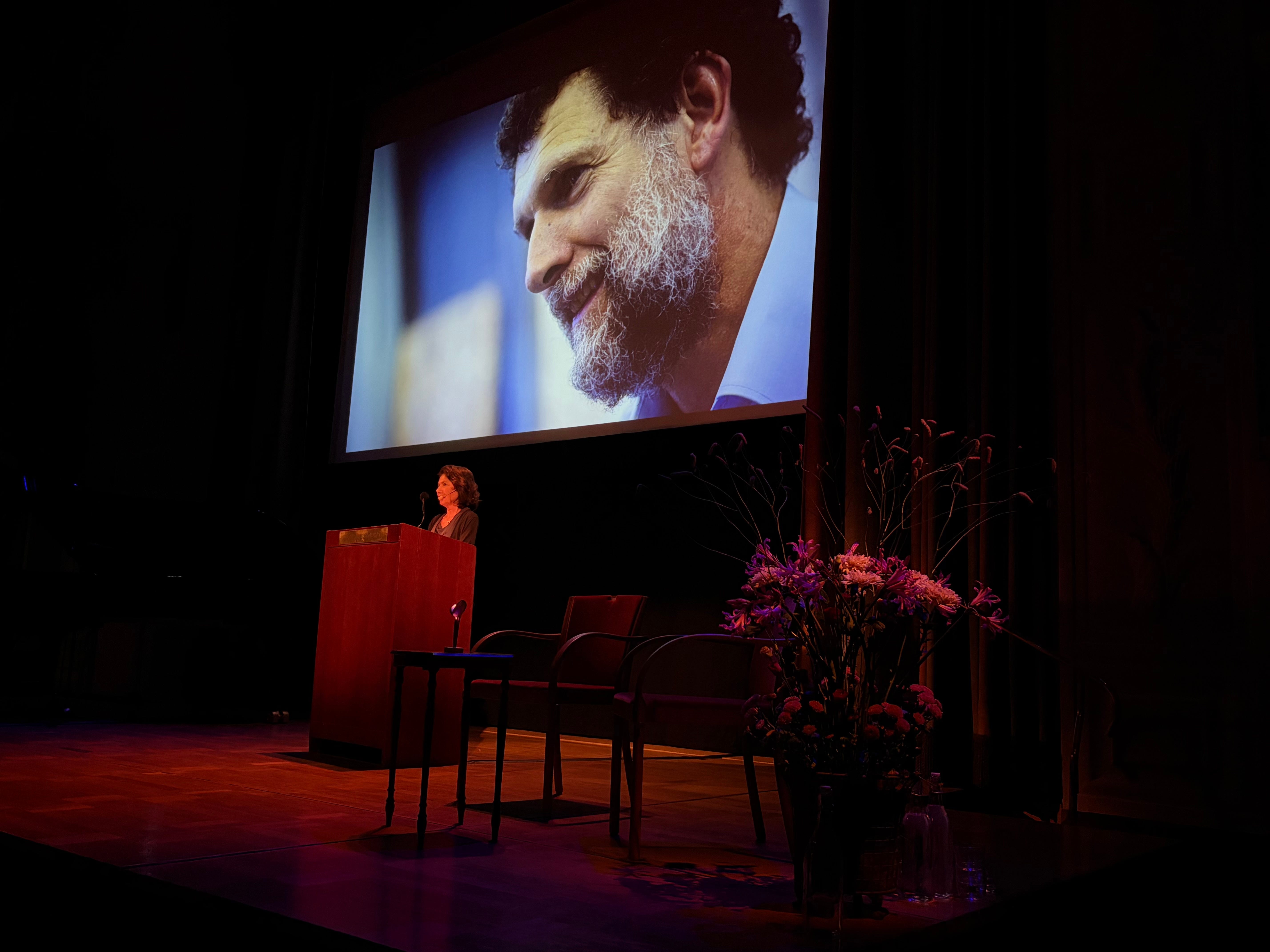
Professor Ayşe Buğra delivering Osman Kavala acceptance speech, which he wrote in his cell inside the Marmara Prison in Türkiye. Photo: Bitte Hammargren
For more about the Award, see Judisk Kultur. In English.